Wednesday, 6 April 2016

Kolkata’s Durgapuja - a Successful Case of Corporatization

Kolkata’s Durgapuja – a Successful Case of Corporatization

If the Durga temple of Aihole (550 AD) is believed to be the oldest Durga Temple in India, we certainly cannot consider this Hindu Goddess to be very young. But quite surprisingly, worshipping the Goddess turned into the biggest annual festival in another part of the India - in the Eastern side; that too, presumably not before 16th century.

History of Kolkata’s Durgapuja goes back to 1690s and since then, the festival became part of Bengali life through many ups and downs. There are lot many aspects of an annual festival in any of the community’s life. But Kolkata Durgapuja has some unique features.
Recent surprise added to this annual festival of Bengalis is probably “Corporatization”.

With the improvement of general economic situation and increasing excitement about globalization, a new touch of glory was added to this annual festival in post 1980's.

But the dramatic twist in this came with the introduction of themes in 1990's and the emergence of corporatism in the whole event. Corporate houses representing different industries started using the festival as advertiser’s canvas. Again, Durgapuja took the lead role in the show that was playing another power-shift in economic history of Bengal. The makeshift pandal was no more a beautifully decorated shelter for the idol, but representation of Bengal's cultural life, people's understanding of global history, politics, economy and current affairs. Painstaking craftsmanship deeply engaged for months was absolute necessity for themes like ancient Egyptian temple or Harry Potter's world. Naturally, individual donations were no more adequate to meet the huge cost. At the same time, count of footfalls in the Durgapuja venues made placing hoardings and banners near the pandal a necessary option for brand promotion. None of the FMCG and consumer goods and service companies doing business in this part of the country could ignore the opportunity. In addition, big puja organizers introduced theme-based festival to increase visitor's attraction. In some place, the pandal looks like Rajasthan Dilwada temple, in some place it resembles to White House. The light artists from Chandannagar and Hooghly (approximately 50000 people in this area are engaged in this business) also developed matching skill in light designing over the ages. Anything from Amartya Sen's receiving Nobel Prize to river pollution control includes in the range of splendor and spectacle they offer. Obviously, business houses and corporate sector found an excellent possibility of product promotion here. Sponsoring pujas depending on their theme, social message and scale of popularity became an unwritten norm for Kolkata Durgapuja festival. 

A Business standard report in 2007 says that corporate sponsorship could amount anything between 20,000 to 3,00,00,000 depending the size of the puja. The most prominent Durga puja sponsors that year included the English daily The Telegraph of ABP group, Nestle, CESC, and Times of India, who have cumulatively sponsored over 200 pujas in Kolkata. For these corporate groups, initiating new Durgapujas in newly growing localities was a profound way to increase customer base. Organizing different other activities like quiz, musical evenings etc besides usual worshiping brought scope for customer interaction and motivating potential clientele as well. “360 connect” including on-ground promotion, hot-spot activity, leaflet activation, sampling and stall activity came up as a concept applicable; especially for Durgapuja event management and sponsorship which attracts approx 3 crore visitors on Kolkata streets. Within couple of years, by 2012, we found presence of almost all business sectors covering FMCG, CDIT, electronics, apparel, mobile networks and apps, automotive, banking etc in the puja sponsor's list. The market forces made the festival a mega corporate event. Same way as the 19th century neo-wealthy class organized Durgapuja to establish them in Bengali society; the 21st century corporate houses found organizing\sponsoring Durgapuja the best option to establish their brand image.

In 2012, Indrani Dutta reports in The Hindu:
“Multinational Standard Chartered Bank has joined hands with the police to support the volunteers who are roped in by the city police to help manage the traffic and the multitudes which throng the 2000-odd pujas in the city and around. The bank will provide T-shirts to the volunteers. Says Dheeraj Ahluwalia, General Manager, Marketing, India and South Asia: ‘This will provide visibility for our brand as the T-shirts would sport the bank logo’.”

Some firms like FMCG Group Emami decided to adopt a direct approach to both product and brand promotion. It will sponsor the oil required for cooking the bhog (rice offering made to Goddess Durga and her children) at a few pujas at the housing complexes. ‘With this unique 360 degree communication plan, we hope to gain an instant emotional connect with our target group of Bengali mothers,’ says Debashis Bhattacharyya, General Manager, Marketing, Emami Biotech Ltd.”

In 2014, the lighting division of Phillips, the Dutch diversified technology company, selected two big puja locations, Mohammed Ali Park and Suhrid Sangha in Rasbihari Avenue to display the advancement of their LED lighting technology  (http://www.youtube.com/watch?v=w01RlOGeGP8); of course by decorating and sponsoring these puja venues. Even jewelers came up to support exclusive puja-venues. The idols in Ekdalia Evergreen club, Gariahat were covered with 18carat gold jeweler and the idol in Sreebhumi Sporting club at Laketown with diamond jeweler worth Rs.10 crore.

Even FDI turned into a reality for Durgapuja. Alliance Françoise, the cultural institute, subsidiary of French Government not only sponsored the Pallimangal Samity's puja in Anwar Shah road to depict the theme of 100 years of Indian cinema, but also send French artists to work with local artisans for the project in 2013. In 2014, Germany crossed the limit of the city of Joy and selected one suburb Puja to tie up with.

We are sure – Kolkata’s Durgapuja will be celebrated many more years – being witness of many more changes in the history of commerce and industries in the country.


Sunday, 20 March 2016

Tagore on Bengali Roopkatha - Fairy Tales of Bengal

Bengali version of fairy tales, i.e. Roopkatha is hardly translatable into English, not only due to immense cultural difference between East and West, but also because of the language the tales are told in. The charm and subtle nature of one folk-language cannot be captured in another language. There lies limitation of languages; we are rarely able to enter into the world of the country folks from geography unknown to us.
There is where my childhood dream of translating Dakshinaranjan Mitra-Majumdar’s Thakurmar jhuli (Grandma’s satchel) - collection of fairy tales of Bengal suffered a big jolt after I actually started working as a translator. But I found the preface of this book written by Tagore in 1908 so appropriate to be considered as a message to translators, that I could not resist translating that part.

Queens waiting for the Parrot-faced ship

Tagore on Bengali Roopkatha:
Is there anything else more indigenous than Thakurmar jhuli? Unfortunate is, even this fascinating satchel is being imported as product of Manchester factories these days. The foreign “Fairy tales” have turned out to be the only option for our kids. Our own Grandma Company seems to have gone bankrupt. You may even find Martin’s ethics or Burke’s notebook of French revolution in their satchel, but where are the Prince and the Nobleman’s son? Where did the Byangomaa-Byangomi and the jewel of the seven kings from the land past seven seas and thirteen rivers disappear?

The tradition of folk festivals, plays, storytelling and elucidation of myths is dying like a drying river. Even the Bengal villages, where these streams of folk flavours used to flow in various branches, are converted into dry desert. The adult minds are being twisted to self-centred deformed ones; but why are our children being punished like sinners deprived from savouring joyfulness? Why is their bedtime so silent? Their reading desks lit by kerosene lamp are crammed with buzzing sound of reading scary foreign spellings. How are we fancying keeping our kids alive by feeding them only chickpeas while completely depriving them from their mother’s milk!

Tales are written in the books nowadays. Where did the tales told by our affectionate mothers vanish? Where are the tales from hearts of the ladies of our land? 

The heart of the Bengal mother was the source of our fairy tales – the Roopkatha, which have been continuously flowing through the minds of our children throughout the history marked by many uprisings and changes in the ruling clans here. These tales are born from the deepest eternal affection, which has raised everyone from the wealthiest king to the poorest peasant in this country, enchanted all of them showing the bright moon in the sky, comforted all by singing lullabies.  

That is reason listening to these stories do not only make Bengali children delighted, it makes them absorb themselves in the eternal flow of Bengal’s deepest affection.

I was hesitating to open the “Thakurmar jhuli” written by Dakshinaranjanbabu. I had a doubt if the steel-sharpness of modern Bengali language did sever that tune of affection. It is difficult to sing in that tune while composing in today’s bookish language. I did not dare taking up this task. I have tried to make an educated storyteller write these stories. Even though written by a woman, under the influence of the foreign pen, those fairy tales lost their fairy-spirit in spite of the tale’s remaining intact – thus making the eternal tale very modernistic.

But Dakshinababu’s effort is commendable! He picked up our grandma’s words and planted them in written form; still their leaves remained as fresh and green as ever. He maintained the simplicity of the old language and unique style of our fairy tales with a fine and natural articulation.

I would propose that, a school for modern grandmothers of Bengal should be opened immediately, so that they can adopt the book written by Dakshinababu, which would in turn help them retaining their past glory in the world of our children’s dreams.    

Wednesday, 16 March 2016

My dealing with a complex topic - feminism

To be honest, I feel little uncomfortable with a word ending in “ism” – this suffix added to a word restricts the realm of the word I think. Take an example of the name – Marx. Who would deny the contribution of the Karl Marx in Western philosophy? But the moment the theory constitutes the area of “Marxism” – it’s for Marxists! Many of us would avoid going close to the fence surrounding the area.
    
Radical thoughts are part of the advancement of civilization. Wasn’t using fire to cook raw meat a radical thought? Wasn’t Copernicus’s idea considered radical in his time? But do these examples encourage us to become followers of “Radicalism”? I doubt!

Almost everyone loves to become patriot, but what about PATRIOT-ISM?  The value of own land and culture is immense to every person. But who defines that one national culture\ interest is so superior to others that its followers should be entitled to impose that standard everywhere in the world? Which route the followers would take to prove that superiority?

I think same happens with the word “Feminine”. We all are comfortable with femininity. But the moment it becomes FEMIN-ISM, we know the topic forces us to look at things conforming to a particular point of view. It excludes people from entering the area of discourse; creates a field for gladiators denying the universal nature of femininity.

One friend suggests me to write for some “feminist” magazine where I have to follow the standard of their style and language. At that very moment, I remembered Chapal Bhaduri – the man who used to transformed himself into a woman representing wonderful women characters from the world of Indian history and mythology. I remembered Kelucharan Mohapatra - his beautiful face of the mythical Radhika I once fell in love with. I remembered the bright pensive face of the male professor, who was going through the painful long process of gender change, sitting beside me and praising my skirt – “I love your dress. Once I become a woman, I will be able to wear dresses like you.” Am I allowed to write about them in the feminist magazine? Or my area of discourse needs to be borderlined by certain physical attributes of persons? Am I supposed to support the causes of the person having a female reproductive system and not hesitating before killing a hundred people in the company to ensure a promotion for herself? Or does the expression of “feminism” also include the subtle face of femininity manifested in persons born with male reproductive system?
 Chapal Bhaduri


Guru Kelucharan Mohapatra

Dictionary meaning of FEMIN-ISM tells reveals this is a “theory of the political, economic, and social equality of the sexes” led by the belief that men and women should have equal rights and opportunities. How many other than some fringe political groups like ISIS deny that equality? Stopping a women from becoming a political or social leader because of her gender is rare notion these days; the world has seen many of them in different countries – more in so-called underdeveloped countries that in so-called developed ones. Only a few countries prevent a women from being an economist or pilot if she wants to and have the capability to become one.

I stay in a country where Durga and Kali and Lakshmi and Saraswati - all females take significant stature among the worshiped deities. Do Siva, Ganesh or Kartikeya create larger scope of business than that Durga, Kali, Lakshmi and Saraswati do every year? I do not have statistics but I have doubt whether the female deities really need to fight against males to establish own equality.

How many of registered Indian companies offer lesser package to their female employees than the males? I do not know of any. Statistics tell IT sector in India hires more women than men at entry level, 51 % as per a recent NASSCOM report. 22% of women applicants get final offers whereas only 15% of male applicants receive offer letter. We cannot deny women laborers face issues in unorganized industry sectors, but male laborers too face lots of troubles there - may be different, but life is not trouble-free for any of the genders.

Right now, when I am writing sitting on my desk – I hear a neighbour couple fighting over some domestic issue. And I hear only the high-pitch voice of the young housewife cursing the man - seems he expected her to cook in the absence of domestic help - not a job for “equal” housewives for sure!
Domestic violence is a hot topic no doubt. If a woman feels that she has been a victim of domestic violence and files a case for separation, the law of the country probably tells that she is entitled to claim a considerable chunk of the man’s earnings. I was wondering if there is a similar law to protect men who are subject to domestic violence. Or it is difficult for a single person to decide how much “equality” is still needed.  

Like most of the favourite topics dominating the discussion of section of academia and accomplished women in Indian drawing rooms, the root of “Feminism” also lies in some other part of the globe. There is no harm in cultural exchange between different geographies. In fact, exchange keeps civilizations alive. But it seems better to go through the social, political and economic status of women in the history of those parts of the globe to understand their context behind starting a movement before finding similarities between them and us – eventually finding examples from my geography which could fit to their context. 

I think we need to go through the history of feminism in the western part of the globe before jumping into their movements. How social, economic and political issues made a section of society feel the necessity to establish own equality with men, make them demand the right to take up same professions as men, change the choice of cloths too  - in turn making them the primary decision-makers for consumer goods in 85% of households. Once a subject of empowerment-advertising campaigns, women are no more "next-emerging" market, but a force controlling the market in all the countries where western economic concepts flourished. Shall we look at feminism through the same glasses we have been using since a hundred years or try to use a different pair of glasses now?


Monday, 29 February 2016

Radicalism - opinion that creates threat

Dictionary meaning of Radicalism is “the opinions and behavior of people who favor extreme changes especially in government  and Radical is the person “believing or ​expressing the ​belief that there should be ​great or ​extreme ​social or ​political ​change.”
Radicalism as a concept can be associated to not only extreme leftist thoughts, but also with extreme rightist Conservatism, Nazism or Fascism. The colour of radicalism changes from one geological boundary to another, depending on the uniqueness of political, social or religious standard maintained in the region. Significance of political radicalism in British and American history is quite distinct. Republican radicals in 1860s America preached for abolition of slavery whereas the Anti- Corn Law League of 1820s, defined as an example of British radicals, took an attempt to lead a moral and religious crusade bringing the end of aristocratic privileges.


Modern world history shows that the character of radicalism remains same whatever philosophy this supports. Theoretically radicals may use violent or non-violent means to bring changes they aim at; and there lies the danger with radicalism.

If our discussion remains within the realm of modern history, “Ism” signifies concept or idea that is believed to be able to rule people’s life. Its survival is very much dependent on preaching. One’s personal belief or even the belief of a very small group of people cannot bring change in social or political or economic environment anywhere, neither this can rule people’s life. Hence, believers in an “ism” try to bring as many people as possible into their belief. Also in case of radical concepts, growing the number of believers is the first stage of its development, similar to any monotheistic religion. In this stage, there is hardly any difference visible between a radical and non-radical idea.

In the second stage, the group of believers strive to bring a big change somewhere with an objective to rule all the people’s life around. Non-radical ideas and their believers tend to bring the targeted change naturally, aligning with prevalent system. Therefore, these changes do not create any turmoil in social, economic or political life. “Green revolution” concept implemented in Indian agriculture sector in 1960s started with an objective of bringing big change in agricultural system. This brought a big change in Indian agricultural community’s life and economy as well. But that did not create uproar of objection.  Difference in case of radical idea is, when the group of believers finds that change\conversion is not possible through non-violent way, they do not mind applying the violent means. Hence, a fascist believes in establishing own supremacy through radicals movements – like Mussolini did. A Nazi radical may believe in elimination of Jews and the Marxist radical in the elimination of inequality by killing unwanted people they call bourgeois.

Post Second World War and post independence India has seen radical movements. Take the example of the one during the process of independence when the radical thoughts of a section of erudite politicians made them understand that dividing the country on the basis of religion would bring cordial changes in the life of independent India. 14 millions of people were displaced. In other words, millions of people had to migrate to unknown future just to have the freedom to follow own religion. That remained largest mass migration in history till date. Properties looted, women and children tortured beyond imagination and people staying in areas marked for exchange had fallen victims of genocide – the number of people killed was no less than 200000. The wound in the affected families never healed.

Naxalite movement in West Bengal in late 1960s started with another radical concept. An uprising of landless labourers was set as a symbol of freedom from oppression by a group of, again lettered leaders, which was determined to eliminate oppression from societies by using Maoist political ideology. Some leaders dictated group members, mostly young students brought into the group by ideological preaching, to annihilate all “class enemies” (mainly businessmen, teachers, landlords, police officers and political leaders) to reach the dream society of “all-equals”. An all out war against the state lead to killing spree – fuelled by radical theoreticians and fanned by Govt. Even pain inflicted from this movement in the minds of affected people never relived.
Let’s not make the list lengthy by citing examples India has seen in last 70 years. What we learnt from our recent history is that, whenever some radical idea was applied to bring (even positive) changes, it produced anarchy. And that is where we see the threat of radicalism.

True there are countries in the world where possession of gun symbolizes power. There are countries where violent revolts are considered to be only option to form desirable social environment. There are western theories which consider unrest a supporting phenomenon behind intellectual development of people.

But common Indian parents do not send children to educational institutes to practice public kissing – things those can be practiced inside home, but to learn how to make a living. Common Indians don’t want their children to become leaders preaching for revolt against state, but to take the role of responsible human being saving their families and societies from disaster.  Spreading radical thoughts shatter the dream of common Indians to have their peaceful meal with all family members around – sometimes three generations present together. Education is supposed to bring positive changes here – slowly and steadily, so that every generation starting from an octogenarian to a newborn finds own place in it. Indians do not want to build their monument of success over the dead. Killing neighbours over their food habit is not considered an option for social cleansing by common Indian. Another thought of splitting the country into pieces (even if that enchants the radical idea of ensuring freedom) brings back the memory of 1947 genocide, or the Kashmiri Pandits helplessly living on New-Delhi streets. That is reason Indian commoners oppose radical thought process – they do not feel safe in turbulence like some of our erudite politicians do.  


Saturday, 27 February 2016

A short trip to Rajasthan - 5

We realized only during our city tour, that the tour operators are not the best option to help visiting Jaisalmer! The RTDC hotel administration works in collaboration with private tour operators who arrange package tour as per their convenience – may not be convenient for the tourist, especially if one likes to take own time to visit preferred places.


Golden fort captured on mobile

Our funniest experience was with Golden fort, ancient home of the Bhatti Rajput dynasty from 12th century AD, later the famous Sonar Kella of Satyajit Ray. By the time we reached at the foothills, the tour operator was in a hurry to take us back to hotel. Moreover, the ambiance of the fort gate is very modern – I had a doubt how I could trace the 24000 women who were believed to have performed Jauhar (practice of self sacrifice, which saved ancient Hindu women from the humiliation in the hands of invaders) in 1290s as defeat became obvious in the hands of the invader Allauddin Khilji. This fort had seen at least three mass jauhars like this – proving the Rajput’s passion for dignity. Jaisalmer was indeed the last Rajput state which came under British rule, by 1818 as British East India Company started swallowing pieces of their Indian pies aggressively. But the entrance, overcrowded with the kiosks, banners (some in Bengali) and over-enthusiast self–proclaimed guides is not welcoming at all. We walked a little, but no - gave up within 10 minutes – we lost the mood to explore in the meantime. Locals told there are luxury hotels inside fort. One may book accommodation in one of those hotels to have a different experience.
Mandir Palace


Palace courtyard

Utensils from Royal kitchen

Lock and keys of Royal Home!


 And old handmade tiles

King's residence

View inside bedroom

The Throne


There are several buildings famous for artwork and handicrafts collection in Jaisalmer, e.g. Badal palace, alternatively called Mandir palace, the 2nd home of Bhatti Kings after they left the fort. This home was built around two hundred years back with the simplicity suited to a desert Rajput dynasty. It’s large but cozy, traditional, exquisitely curved, but not gaudy – part of which is again converted into luxury hotel (not too costly one). The Ladies Zone and the Kings area with a display of items for daily use and artifacts open for visitors show the distinct character of its owners. Probably this distinct identity was the reason behind many battles between Bhattis of Jaisalmer and Rathors of Jodhpur and Bikaner. 
Tajia tower

Ancient myth says that the establishment of this dynasty as a dominant force is resulted from the friendship between Brahmins – the scholarly class and Rajput – the warriors. Later, as Jaisalmer was developed as a large trading point between India and Pakistan, the Islamic art form was also adopted to create marvels of Jaisalmer architecture. Tajia tower in Badal palace is a magnificent example.


One of the horses in the king’s stable seemed very friendly. Not only he walked to us but also started trying to communicate - probably being attracted by my brother’s heavy jacket and my leather bags. Unfortunate that all horses have caretakers to scold them if they are interested in unknown people!

Gadisar lake is another architectural marvel worth visiting. The man-made lake was excavated as a water reservoir for the city of Jaisalmer by the king Maharwal Gadsi Singh around 1400 AD. Migratory birds are one attraction of this lake in this season. Obviously they prefer the less crowded part of the lakeside – opposite side of Tilon ki Pol. We decided not to disturb them here and kept ourselves busy with the gate. The gate was constructed by a courtesan Tilon. Of course making of such a large sandstone structure by a courtesan did hart the social pride as well as the king’s then. So a Satyanarayan (another form of Krishna) temple was also built along and the gate was dedicated to that God – doing away with all debates.
View of the lake taken using mobile

Tilon ki Pol

A view of ghat and temple


Patwon ki Haveli is a complex of five houses made by an 18th century business tycoon, who even lend money to the royals, for his five sons. Details: http://patwahaveli.com/history.asp Each house can be considered separate art galleries, full of artifacts showing the lifestyle of the old business community here.


We have heard of Nathmal ki Haveli too as a mansion worth visiting; but the operator-controlled time of city visit was over for that day as well and then the tour operator wanted to take us to the trip towards Indo-Pakistan border – we were not interested and decided to take rest instead.

People attracted to archaeology and ancient art may find Jaisalmer museums interesting too. A List of Rajasthan museums is available here: http://museumsrajasthan.gov.in/museums.htm

Things went fine till the reservation chart of the train Jaisalmer-Jaipur was prepared. My brother arranged everything beforehand taking extra care while he was carrying 2 old ladies along. We were on waiting list 1 2 3 for this train, confident that we would get the tickets confirmed on time. Such a wrong idea! After chart preparation, only 1 was confirmed; the name was my brother's! So we needed to cancel all, but how to reach Jaipur next day then? As hotel staffs referred a bus operator, my bro went there to book a ticket but came back with a visibly shocked face – knowing that a Jaipur bound bus ticket costs as low as Rs 450 for an overnight journey. We took an auto rickshaw towards bus station. As it happens in India, we started chatting with the rickshaw driver. Knowing our travel plan, he commented “who referred you the ‘Bangar’ (broken) bus?” Then we came to know that there were options for other kinds of buses too – Volvo and all. But no – we were not in the mood of changing tickets – anticipating this bus could be our option of catching another glimpse of rural Rajasthan. We were right! Ours was a bus used by local commuters, without air-conditioning, cold air coming through its cracked body. Wonderful was to find that even that bus was being managed by an expert driver and a nice conductor, probably little concerned about the safety of this group of three city-bred differently dressed visitors. We were given best possible seats and the conductor kept on guarding us. It stopped at a roadside dhaba at midnight for dinner. My brother went to discover the taste of rural Rajasthan and came back with a pleased face. Dhaba food, according to him is in general healthy and tasty in India. Their food is made of fresh ingredients and served hot. Me and mom were shown an open space behind the Dhaba as we were looking for an washroom! IMAZINE! Hmmm – we have to take things easy when we are travelling rural Indian style!
The bus ride was rewarding as imagined. Pokran in Sonar Kella, the Satyajit Ray detective story of 1970's was a deserted place. We discovered that to be a grown up township now. I found, that ladies in rural Rajasthan wear skirts more beautiful than those we get at stores and, that people are very tall and thin in this part of Rajasthan. We also got a chance of trying a mix of hot toasted chickpea, peanut and some unknown nuts – some local mouth watering delicacy.

As we got down from bus at 4 AM, my legs were almost frozen; probably bro’s too; both smart siblings boarded a country bus in Rajasthan winter without wearing warm leggings!

Fortunately our Jaipur cab driver picked us up without much delay. A nice warm room is something you need after such an adventure. But morning truly showed the day – my decision of city visit that day went terribly wrong. We should have visited city palace, jantar mantar etc, before visiting the forts. These are favored destinations for foreign tourists which give an idea of Indian royal grandeur during colonialist period. After forts, palaces seem too ordinary. There is no Nahar Singh as well.
Inside Jaipur palace

I think Mysore palace could be a better attraction for people who love to see lot of gold and silver – even the Hookah collection of the Ramnagar king (Banaras) could stand as good competitor against Jaipur city palace hookahs.  Indian Museum or Victoria Memorial or Marble palace in Kolkata has excellent collection of artifacts. To me, Rajasthan is alive for its stories integrated with its monuments and palaces. But there are more of history than stories in last 200 year’s India…
The old Jaipur (mobile)
Old Jaipur city is interesting for its old pink houses made in rows. The main road is wide but encroached from all sides keeping only a narrow passage open for all kinds of vehicles! It made me remember the dingy Burrabazar area in Kolkata – the wealthiest business neighborhood in the city. Interestingly, old Burrabazar residents are mostly from Rajasthan. Well, many of Rajasthan trading community started settling in eastern part of the country long before the British arrived.


Mobile cam is only option from inside car 

Jaipur nowadays is clearly divided into old city and new – we partly had a glimpse of the old during the fort visits. The old Jaipur city was developed during British era – in last 200-250 years as the royals started living in newly built palaces leaving their old forts. But as it happens with all old cities – one can feel the place only by walking miles on its roads…   
The divider between the old city and new (mobile)

Which cannot be maintained everywhere (mobile)

Regret for not having much time to explore more of the city while in the meantime, my old faithful headache announced its presence. We had to rush to hotel.

Not only buildings and stories, this part of Rajasthan amazed me with lot more. I found the Food and sweets and snacks simply delicious! As eastern side of India invented cottage cheese sweets, Rajasthan offers own creations using condensed milk, lentil flour, wheat flour, rice flour and ghee. Foodies should never miss different varieties of Laddus, Ghewar and Pheni and Kachouris as well as their thalis. Secondly, these cities of Rajasthan are good shopping destination as well, especially for those having a taste for handloom and handicrafts, silver and copper and stoneware. But if one does not have local contacts, it’s better to trust Govt. emporiums than any random store. I regretted not having a job when I realized I would never get gemstones and semi precious stones at that price anywhere else. Shame to my poverty! 

Next morning, when the city of Jaipur was getting smaller and smaller below, I remembered some families from Delhi, Kanpur and Allahabad I met in the Jaisalmer hotel - how we spent a nice evening chatting in the lounge. The government officials from other states were amazed at the grand success of Rajasthan Govt. in maintaining the city clean and supplying enough of water. The civil engineer from Delhi, who was listening silently in the beginning, suddenly commented: “But there is no rain since last three years. True, water is made available for tourists who might find desert life romantic. But fact is, one can work full time only 6 months a year here whereas moving out of home is not possible in summer. Moreover, water is costly when there is no rain. So it’s not all rosy pictures for the locals. I think, all the places are good when you see them as a tourist – but to stay, only that place is good which gives you a job.” – making the rest of us silent!

I don’t know whether he was right or wrong – but I knew there were lot more of Rajasthan remained hidden from us – tourists who have to visit places within a span of few days.

Photo courtesy: Tathagata Mukherjee

A short trip to Rajasthan - 4


We started for Jaisalmer by train at midnight; reached again facing a delay of two hours due to fog. At 7 am in the morning, we found a cold dark night outside the station. Anyway, we escaped any kind of trouble as the cab sent from hotel was waiting.

Cottage in Jaisalmer hotel

Tourist lodges\hotels under Government tourism departments in India have an ambiance we call middle-class environment. In the lobby, you may find tourists who work with different departments under different state- or central governments, chatting with each other. Rooms look like Govt. quarters, food is healthy\less spicy. You may also find a cottage industries showroom in the premises. These do not include gym, swimming pool, sauna or parlor, but provide homely comfort for Govt. employees families. I do not know how a similar kind of environment is maintained in all Govt. lodges everywhere in the country – as I have seen – be in West Bengal or Orissa, Karnataka or Tamilnadu, Maharastra or Rajasthan. 
Towards desert

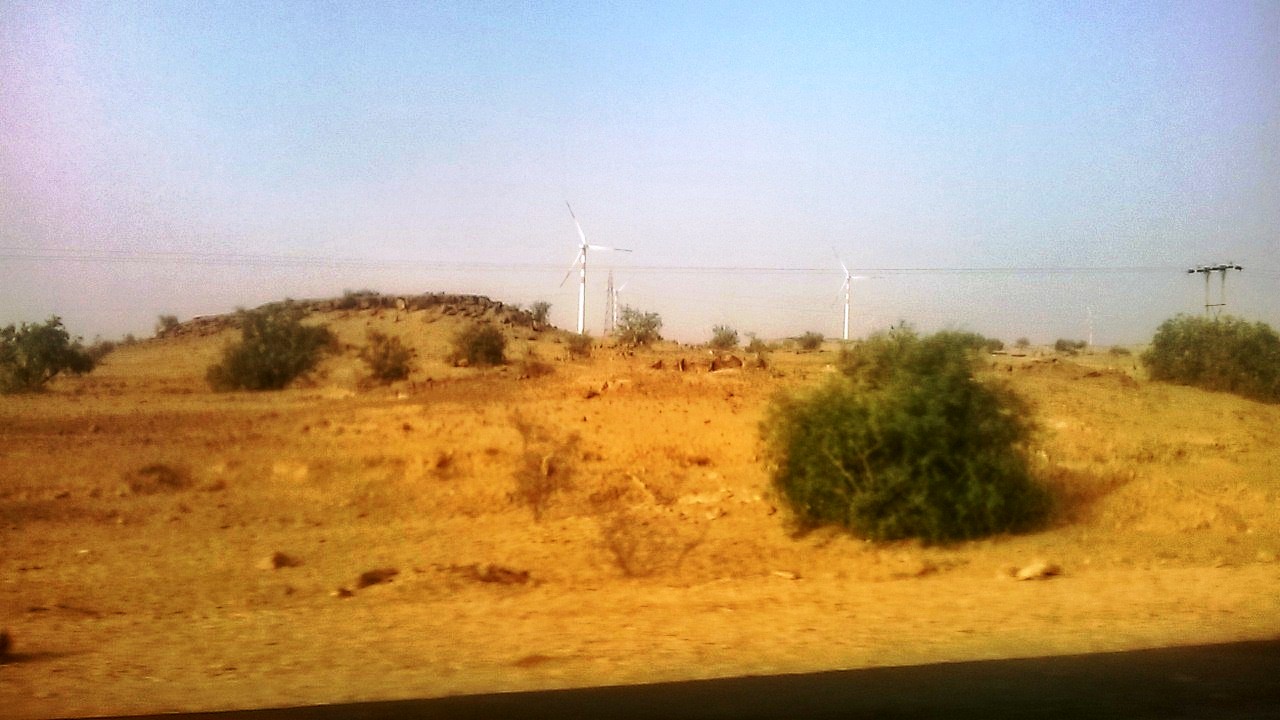
First desert visit has to be exiting, so was ours. Jaisalmer city is in the desert, but one needs to drive almost half an hour to find a deserted desert. Well, roads are good even in those areas. There was more surprise for me on the way – windmills! I haven’t seen those from so close distance before. 

Ruins of Kuldhara
Kuldhara is a famous haunted village in the desert being maintained by Archaeological Survey of India. There is a debate whether a nasty Rajput local leader really threatened a group of Paliwal Brahmins so harsh that they preferred leaving their Kuldhara home and losing in the desert rather than gifting one of the Brahmin daughters to the Rajput. But stories do tell about people of a place and time – this place must be a witness of some incident. Some friends told Paliwals were into gold trading, so it is very possible that a local ruler of some unknown era wanted to acquire their gold, not really their daughters and he made Paliwals leave the place to fulfill his objective. Who knows the truth?


One old home renovated in Kuldhara

There was a temple once

Desert through mobile cam

Camel ride was fun for me and my brother. The camel was growling as we stepped towards it. Obviously this made me little scared (remember Lalmohan Ganguly?). What a wonder, it stopped crying as me and bro sat on it. What a personality trait - it seemed happy not only to carry heavy stuffs clinging on its back but also wanted to run with those! Its owner told, camel is energetic animal, especially when young. They don’t want to sit idle and express dissatisfaction till there is no chance to move. Does every camel have same character or this is also a generalization?

The big fat heroin and brother

Keeping balance may seem little troublesome in the beginning but you will enjoy the ride. I would be happier only if “tourists” did not take the role of garbage producing community here – how come people scatter all kinds of plastic bags, wrappers and bottles around themselves? Also beware of the proposal of camel-owners to show the Indo-Pakistan border, which is, in fact 130 km away from this part of Jaisalmer. Well – no harm in taking a longer camel ride if you enjoy.

In the desert

Dusk in the desert

The fire
Musical programs presented by folk artists arranged in the evening are another attraction in the deserts. People may also live in the tents here or go back to hotel after attending the program. You are lucky if you are attending a program of one of your favorite singers. There is a difference between listening to a Manganiyar artist in a city auditorium and out in the open. Seats for audience are arranged like a gallery in the open  – the program starts after sunset in the evening - in January the temperature goes low as 4/5 oC – they light a fire in the middle. Probably this is called heavenly experience!

Practicing before performance
Jalal Khan and troup
Shanta Devi and troup


Our little fotomodel

To be continued: